A new batch of South Korean K2 Black Panther tanks has expanded Poland’s armored force in the northeast, adding to a broader defensive buildup around Kaliningrad and the Suwałki corridor.
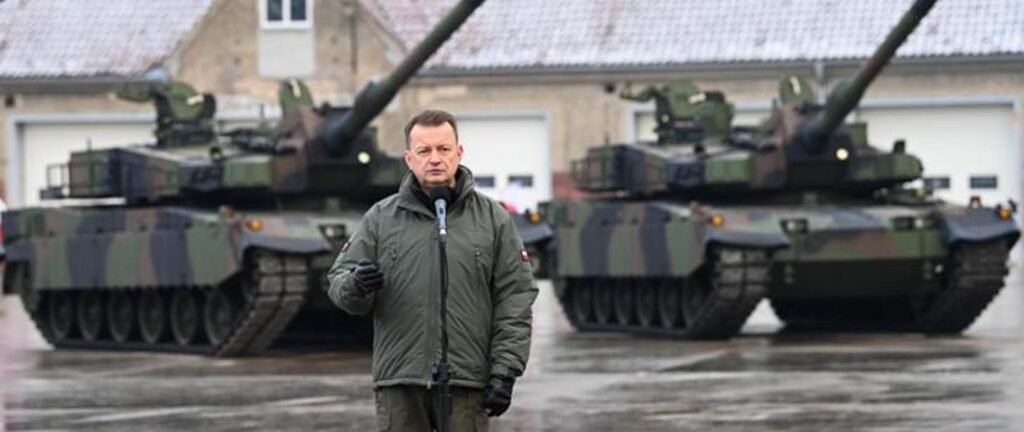
Poland’s acquisition of South Korean K2 Black Panther tanks is changing the composition of its armored forces, especially in the northeast of the country. In late August 2026, Poland received another 28 K2s under its second executive contract with Hyundai Rotem. Polish defense reporting said the delivery brought the number of K2 tanks in Poland to 208 and that the new vehicles would reinforce the 16th Mechanized Division.
That location is important. The 16th Mechanized Division operates in northeastern Poland, close to Russia’s Kaliningrad exclave and the Polish-Lithuanian frontier. The deployment therefore connects an equipment modernization program with one of NATO’s most closely watched pieces of geography.
WHY KALININGRAD AND THE SUWAŁKI CORRIDOR MATTER
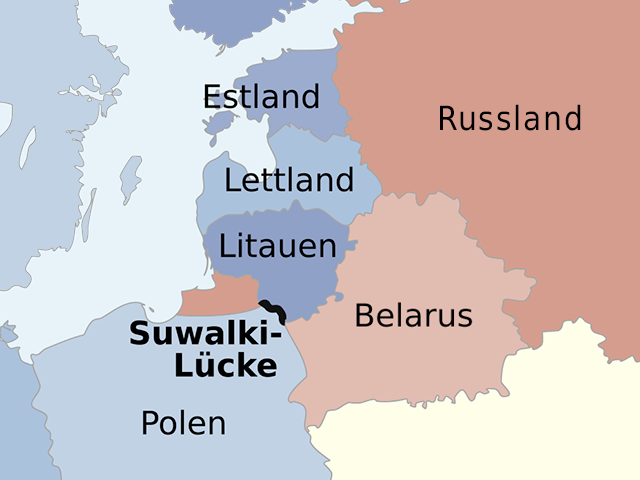
Kaliningrad is a detached Russian territory on the Baltic Sea, bordered by Poland and Lithuania. Immediately to its east and southeast lies the Polish-Lithuanian border area commonly referred to as the Suwałki corridor or Suwałki Gap.
The corridor matters because it is the land connection between Poland and the Baltic states. In a conflict involving NATO and Russia, the area would be important for reinforcement, logistics and movement between the Baltic region and the rest of the alliance.
That does not mean a clash there is inevitable. It does mean that military planners on both sides pay unusual attention to a relatively narrow area containing roads, railways, forests, lakes and border infrastructure.
Poland’s buildup should therefore be understood primarily as part of a deterrence and forward-defense posture rather than as evidence that a specific operation is imminent.
The K2 Force Is Now Large Enough To Matter At Formation Level
Poland’s first executive contract covered 180 K2 tanks, all of which were delivered by late 2025. A second contract signed in 2025 covers another 180 tanks: 116 K2GF vehicles and 64 K2PL variants. Poland’s Ministry of National Defence says the second contract will be delivered over several years and includes support vehicles, training, logistics and technology transfer.
The late-August 2026 delivery consisted of 28 additional K2s. Polish reporting said they were assigned to the 16th Mechanized Division, bringing the national K2 inventory to 208.
The distinction between a few demonstration vehicles and hundreds of operational tanks matters. At this scale, K2s can equip multiple battalions and support sustained training, readiness and force rotation rather than serving only as a small specialist capability.
The K2 is a 55-ton main battle tank with a 120 mm smoothbore gun, autoloader, 1,500-horsepower diesel engine and hydropneumatic suspension. Poland’s Ministry of National Defence also highlights its modern fire-control system and digital battlefield-management capability.
The forthcoming K2PL version is planned to add further protection and Polish-specific modifications, including additional armor and systems intended to improve survivability against contemporary threats.
The Buildup Is About More Than Tanks
Poland’s northeast is not being reinforced with armor alone.
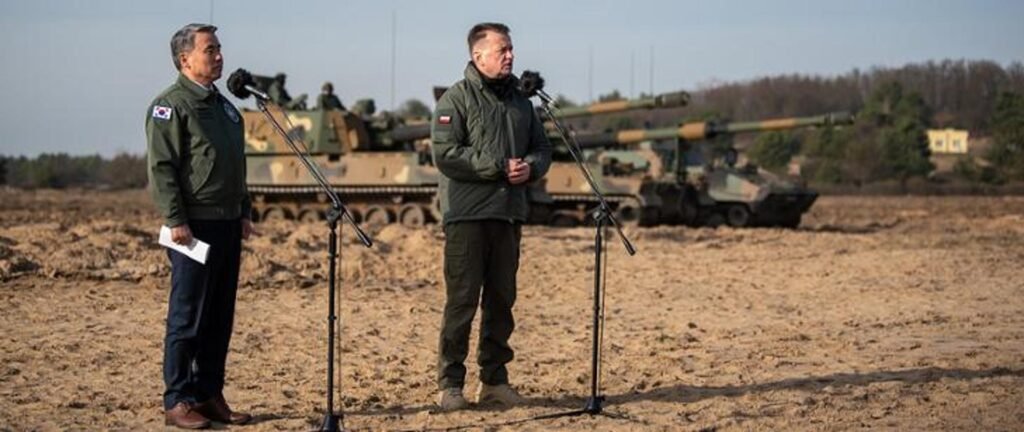
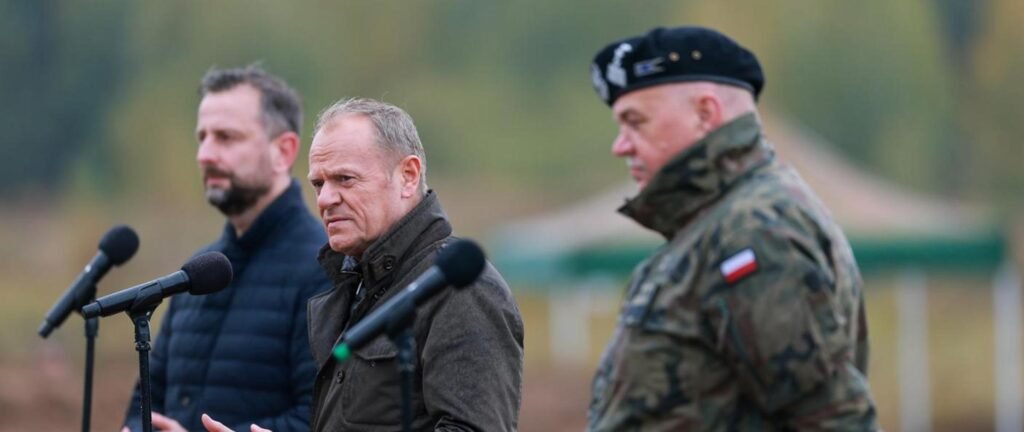
At the same time, Poland is investing heavily in fixed and semi-fixed defensive infrastructure along its eastern frontier through the Shield East program.
The Polish government describes Shield East as a long-term effort to impede hostile movement, improve the mobility of Polish forces and protect soldiers and civilians. The program includes fortifications, obstacles, reconnaissance, anti-drone systems, communications infrastructure and military logistics facilities.
This is a different form of defense from buying tanks. Armor gives commanders mobile combat power. Fortifications and obstacles shape where an attacking force can move. Reconnaissance and anti-drone systems improve warning and protection. Logistics facilities help keep the entire system supplied.
Together, those layers are intended to make a rapid breakthrough more difficult and to give defenders more time and better prepared positions.
Shield East exercise and defensive infrastructure. Credit: Chancellery of the Prime Minister / gov.pl (CC BY 3.0 PL unless otherwise stated on source page).
South Korea Has Become A Major Supplier To Poland
The K2 program also illustrates a broader shift in European procurement.
Poland turned to South Korea because Korean industry could deliver large numbers of modern armored vehicles on a relatively short timetable. The relationship now extends beyond tanks to K9 howitzers, FA-50 aircraft and other systems.
For Warsaw, speed has been a major factor. Building new domestic production capacity takes time, while the security environment on NATO’s eastern flank has created pressure to field equipment sooner.
The second K2 contract is designed to combine near-term imports with greater Polish industrial participation later. Poland’s defense ministry says 64 vehicles will be in the K2PL configuration, with most of those planned for assembly in Poland.
That makes the program both a military procurement project and an industrial partnership.
What The K2 Does — And Does Not — Change
The K2 is technologically advanced, but no tank changes the military balance by itself.
Modern armored warfare depends on artillery, air defense, drones, electronic warfare, engineers, logistics, reconnaissance and infantry. The war in Ukraine has repeatedly demonstrated that even sophisticated tanks are vulnerable when they operate without those supporting systems.
Poland’s wider investment is therefore more important than any single specification of the K2. The strategic effect comes from combining armor with artillery, engineering obstacles, sensors, anti-drone defenses and allied reinforcement plans.
Russia also retains important military capabilities in Kaliningrad, including missile systems, air defenses and electronic warfare. The exclave remains militarily significant even if the conventional ground-force balance around it changes.
The result is not a simple tank-versus-tank comparison. It is a contest between larger military systems.
Kaliningrad’s Geography Cuts Both Ways
Kaliningrad’s location gives Russia military reach into the Baltic region, but it also creates logistical constraints. The territory is separated from the Russian mainland, which means reinforcement and supply depend heavily on maritime routes and transit arrangements across neighboring states.
In peacetime, those routes support ordinary economic and military activity. In a severe crisis, geography would become much more important.
That is one reason the Suwałki area attracts so much attention. The same geography that gives Kaliningrad strategic value also makes the surrounding region sensitive to reinforcement, access and mobility.
For NATO, maintaining reliable land connections to Lithuania, Latvia and Estonia is important. For Russia, maintaining access to Kaliningrad is important. Defensive planning on both sides therefore concentrates on the same narrow region for different reasons.
The Bigger Change Is Poland’s Force Structure
The most important part of the 208-tank figure is not the symbolism of tanks near a Russian border. It is what the number says about Poland’s military modernization.
Poland is replacing older Soviet-designed equipment with a mix of K2s, Abrams tanks, K9 artillery and other newer systems. This requires new training, maintenance, ammunition, logistics and command networks. The transformation is therefore much larger than the arrival of one shipment.
The 28 tanks delivered in August 2026 are one tranche in a multi-year program. More K2GF tanks are scheduled under the second contract, followed by the K2PL version.
As those deliveries continue, the 16th Mechanized Division and other formations will have increasing access to modern armored equipment. How much of that equipment is permanently concentrated near Kaliningrad will depend on basing, training and operational requirements; the contracts themselves do not establish that all 360 tanks will be positioned on one border.
That distinction matters. Procurement totals should not automatically be interpreted as a single fixed deployment.
What To Watch Next
The next important developments are practical rather than rhetorical.
First is the pace of K2 deliveries and the transition toward the K2PL variant. Second is the expansion of Polish maintenance and production capacity. Third is the progress of Shield East infrastructure and the integration of anti-drone, reconnaissance and engineering systems with maneuver units.
A fourth issue is allied reinforcement. Poland’s northeastern defenses are part of a broader NATO posture that includes multinational forces, air policing, logistics corridors and exercises.
The military significance of the K2 program will therefore be measured less by one delivery ceremony than by how effectively the tanks are integrated with the rest of the force.
Poland now has a much larger modern armored fleet than it did only a few years ago. Around Kaliningrad and the Suwałki corridor, that buildup adds weight to a wider strategy: make the northeastern frontier harder to penetrate, easier to reinforce and more expensive to challenge.